
In the complex landscape of international procurement, most buyers rely on a single document: the Laboratory Test Report. If it says "Pass," they ship. But as a project director with 19 years of experience on-site in China, I’ve seen where the real risks hide—in the gaps between international standards.
The Reality Check: Navigating the Compliance Gap
Recently, we conducted a technical audit for an Australian residential project. The client initially requested testing under the Australian AS/NZS 4456 standard. However, our professional audit revealed a significant industry hurdle: Currently, no laboratory in Mainland China (including international giants) holds the ILAC-MRA accreditation specifically for the Australian Concrete Paver standard.
To ensure the client received a report with the "Global Gold Seal" (ILAC-MRA) necessary for Australian building certification, we recommended the Chinese GB Standard path—the only accredited route in China for concrete products with full international reciprocal recognition.
The Digital Audit: Identifying the Risks
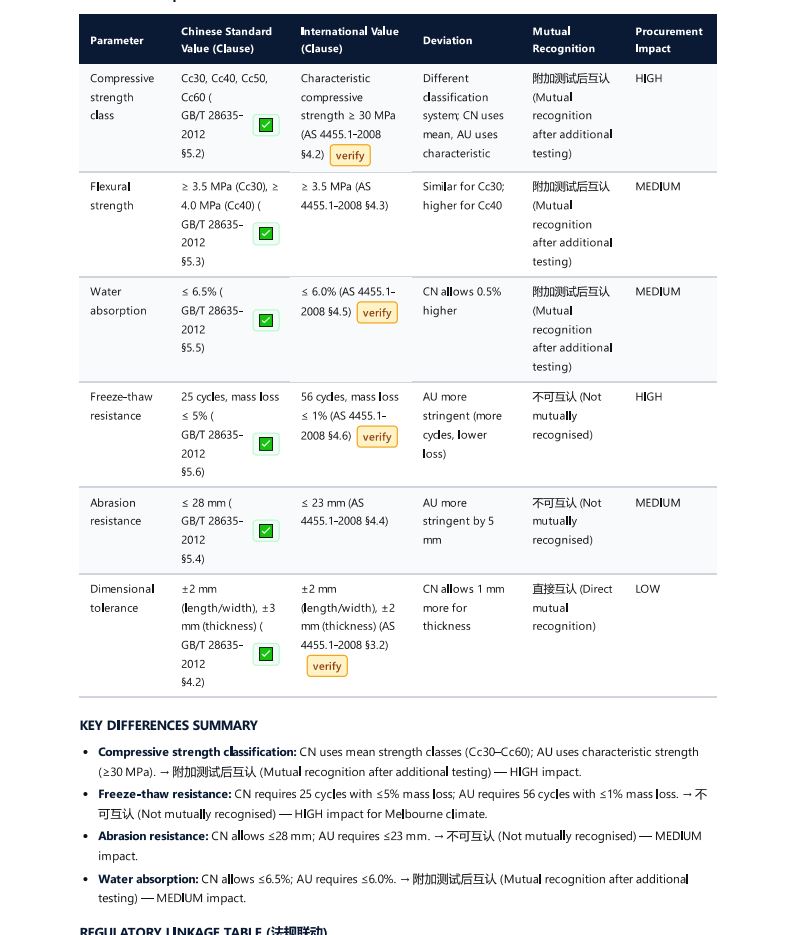
Using our proprietary alignment engine at cnqualitycheck.com, we identified critical technical gaps that a "Pass" report alone would not reveal (as shown in the comparison table above):
- Durability Discrepancy: The Australian standard traditionally references a 56-cycle freeze-thaw threshold, while the basic GB standard utilizes a 25-cycle methodology. This represents a significant gap in performance verification that must be managed through engineering oversight.
- The 1mm Precision Risk: The Chinese GB standard allows for a ±3mm thickness tolerance, whereas the Australian standard strictly requires ±2mm. In high-end residential paving, that 1mm difference is the boundary between a flat driveway and a trip hazard.
- Calculation Logic: A fundamental difference exists between "Mean Strength" used in China and "Characteristic Strength" required in Australia.
The Solution: Why Witnessing is Non-Negotiable
Data on a screen is just the starting point. Because the standards are not equivalent, on-site witnessing becomes the final line of defense.
As a Licensed Engineer, I use these audit findings as a "Risk Map" during my factory visits. We compensate for the standard gaps by personally verifying material density, water absorption, and dead-accurate thickness tolerances. We don't just hope for quality; we supervise it into existence.
Don't just hope for compliance. Engineer it.
Need an independent inspection in China?
Request a Quote →